
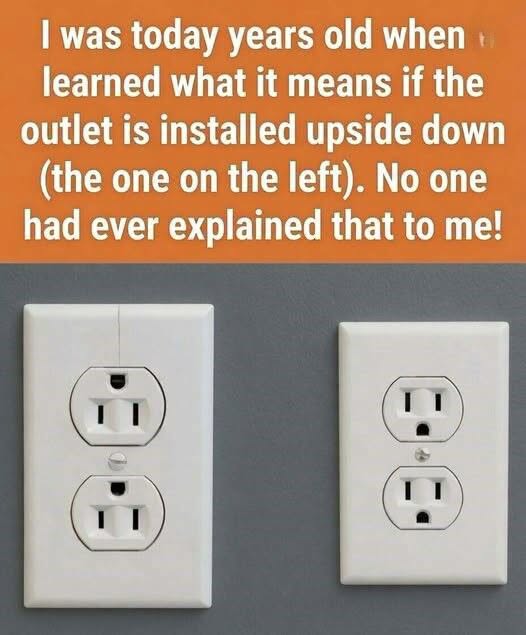
If you’ve ever spotted an electrical outlet with the ground hole positioned at the top rather than the bottom, you may have assumed it was installed incorrectly. In many cases, however, this orientation is intentional and serves a practical purpose. Electricians and builders sometimes install outlets in different positions to help identify specific wiring configurations or accommodate certain design preferences. What appears unusual at first glance is often a deliberate feature rather than a construction mistake.
One common explanation involves switched outlets, which were especially popular in older homes before ceiling lights became standard in every room. These outlets were designed to power table lamps or floor lamps that could be turned on and off using a nearby wall switch. Installing the outlet upside down occasionally provided a convenient visual cue that it operated differently from other outlets throughout the home. In some installations, only one receptacle is connected to the wall switch, while the other remains continuously powered for everyday devices.
It’s important to know that outlet orientation is not governed by a universal residential standard. Electrical codes generally focus on safety and proper installation rather than requiring outlets to face a particular direction. As a result, practices may vary depending on the home’s age, local building customs, or the electrician’s personal preference. Some homeowners simply prefer the appearance of upside-down outlets, while others may encounter them in commercial settings where certain orientations can offer practical or safety-related advantages.
If you’re curious about whether an outlet is controlled by a switch, the easiest solution is to test it. Plugging in a small lamp or another simple device and checking nearby wall switches can quickly reveal how it functions. Understanding these small details can help you better appreciate the design choices found throughout your home. Sometimes, what looks like an installation error is simply a thoughtful feature that reflects the home’s electrical layout and history.