
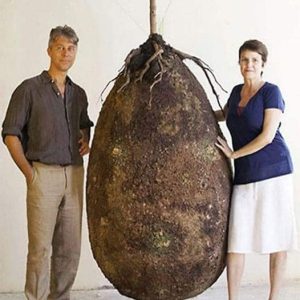
Caskets, burial plots, grave markers, and all the trappings associated with traditional funerals are not only intricate but also quite expensive! And let’s face it, they’ve been around forever and could definitely use a modern update.
Enter two innovative Italian designers, Anna Citelli and Raoul Bretzel, with their groundbreaking project known as “Capsula Mundi.” These visionary capsules are designed to cradle the deceased in a fetal position, revolutionizing the concept of final resting places.
Crafted from 100% biodegradable materials, these organic capsules facilitate a remarkable transformation: over time, the body inside decomposes, nourishing a sapling planted above it, ultimately turning the deceased into a flourishing tree.
How does it work? It’s surprisingly simple! The body is nestled into the capsule, then buried in the earth. Instead of traditional markers like crosses or headstones, a seed or sprouted sapling is planted atop the capsule.
And here’s the kicker: while you’re still kicking, you get to choose the tree species that will one day become your final form. It’s akin to selecting a coffin model or specifying funeral arrangements, but with a green twist.
As time passes, the body naturally breaks down, providing essential nutrients for the tree’s growth, creating an uninterrupted cycle of life.
“This is a groundbreaking initiative aimed at promoting eco-friendly cemeteries,” according to the capsulamundi.it website. “Capsula Mundi is buried like a seed, with a tree planted above it. The tree species is chosen by the individual during their lifetime, with friends and family tending to it after their passing.”
No longer will cemeteries be filled with somber crosses and stone markers; instead, they’ll evolve into serene forests, serving as sacred memorials to those who’ve passed.
“Capsula Mundi not only preserves trees but also advocates for the planting of new ones,” explain Anna Citelli and Raoul Bretzel. “By planting diverse trees side by side, a forest is born—a place where children can learn about nature and where loved ones can find solace.”
While this concept originates in Italy, where it’s not yet officially sanctioned (blame the Pope in Rome, perhaps), it’s gaining traction in the United States and England, where it’s already proving successful.