
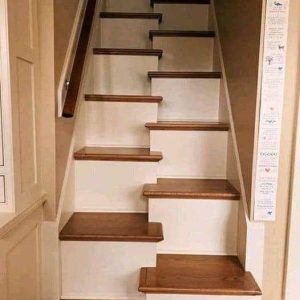
A distinctive architectural feature known as witches’ stairs gained attention on TikTok a couple of years ago, sparking curiosity due to its unusual design. Despite its intriguing name, the history behind these stairs defies superstition, proving to be both functional and visually appealing.
Contrary to popular belief, witches’ stairs aren’t rooted in superstition. They serve a practical purpose, especially in homes with limited space, often found in attics, lofts, and tiny houses. Architects refer to them as ‘alternate tread stairs,’ designed to optimize space while facilitating movement between floors.
Staircase with wavy steps with a trash bag and floor mat in the background.
Witches’ stairs feature narrow steps staggered to save space, providing functionality without sacrificing safety. Additionally, they can serve as storage areas for books or decorative items. These stairs meet building codes and safety standards, with residential versions typically spanning 27 to 30 inches in width, narrower than standard staircases.
In 1985, entrepreneur J.M. Lapeyre patented a metal version of witches’ stairs, originally conceived as a safer alternative to ladders in commercial and warehouse settings. The design, also known as ship stairs or alternate tread stairs, found utility in various industries beyond residential use.
Despite urban legends associating witches’ stairs with 17th-century Massachusetts and the Salem witch trials, historical evidence contradicts these claims. The true origins remain somewhat obscure, but there’s no basis for the belief that these stairs were intended to deter witches.
While the true history of witches’ stairs may elude us, their distinctive design adds character and functionality to modern spaces. Whether considered a quirky decor choice or a practical innovation, witches’ stairs continue to captivate and intrigue.