
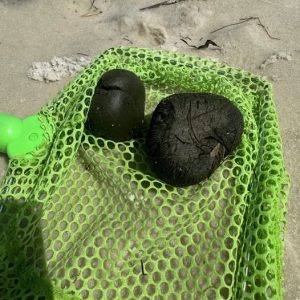
If you’ve ever walked along Pensacola Bay with kids, you may have heard excited laughter followed by a proudly announced discovery with a very unfortunate nickname. These oddly shaped, dark clumps often spark curiosity and amusement, but they’re not mysterious—or gross—once you know what you’re looking at. The first step is understanding that these finds, commonly called mudballs, are a completely natural part of the bay’s shoreline and a sign of how active and alive the coastal environment really is.
Mudballs form when soft, clay-rich sediment from the bay floor breaks loose due to waves, tides, storms, boat wakes, or even people walking in shallow water. Once detached, these small chunks are rolled along the bottom by gentle currents. Over time, sand and silt smooth their edges, gradually shaping them into rounded, compact forms—much like how pebbles in rivers or sea glass on beaches become polished through motion.
Recognizing what a mudball looks and feels like helps ease concern. They’re usually firm but slightly pliable, dark in color due to organic material, and typically odorless. They don’t leave oily residue and aren’t harmful to touch. If something feels sticky, smells strong, or leaves a sheen, it’s best left alone—but standard Pensacola Bay mudballs are harmless and often appear after storms or during low tides when more of the shoreline is exposed.
Finally, it helps to see mudballs as part of the bay’s natural rhythm rather than something strange. Over time, they break down and return nutrients to the ecosystem, supporting marsh plants and microscopic life. For families, they often become part of beach-day memories—lined up on the sand, compared for size, and laughed about for years afterward. Sometimes, the simplest discoveries offer the best lessons: nature is always shaping, recycling, and quietly telling its story—one muddy surprise at a time.