
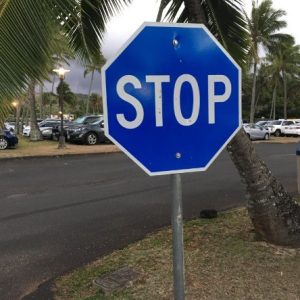
Seeing a blue stop sign can be surprising, especially if you’re used to the familiar red ones on public roads. While these signs do exist, they are not officially issued or regulated by the U.S. Department of Transportation. Blue stop signs are most often found on private property such as gated neighborhoods, college campuses, industrial sites, or parking areas, where traffic rules are set by property owners rather than public agencies.
To understand why blue stop signs are unusual, it helps to know how traffic sign colors work. Over time, specific colors were assigned clear purposes to keep driving intuitive and safe. Red became the standard for stop signs by the 1950s because it strongly signals danger and commands attention. Yellow warns of potential hazards, green provides directions, black-and-white signs regulate behavior, and blue is typically reserved for services like hospitals, rest areas, or emergency assistance.
Because blue does not traditionally signal “stop,” it breaks established traffic design conventions and is not permitted for official public-road use. However, on private property, owners can install nonstandard signs to guide traffic flow. These signs may not carry the same legal authority as public road signs, but they still play an important role in organizing movement and reducing the risk of accidents in controlled areas.
The safest approach when encountering a blue stop sign is to treat it exactly like a red one. Even without federal enforcement, ignoring it could result in local penalties, property rules violations, or accidents. Blue stop signs may be unconventional, but their purpose is practical: promoting safety. They serve as a reminder that while not all traffic signs follow the same standards, responsible driving should always come first.