
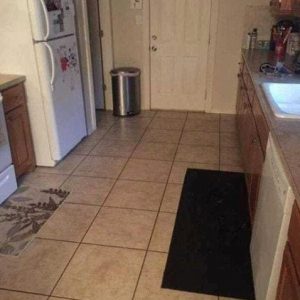
At first look, the kitchen seems completely unremarkable—tidy counters, neutral tones, and no obvious surprises. But this image isn’t as simple as it appears. Somewhere within the scene is a dog so well blended into the surroundings that many viewers miss him entirely. Optical illusions like this work by taking advantage of familiar settings, where our brains assume we already know what we’re seeing and stop searching for anything unexpected.
The challenge gained popularity because it feels deceptively easy. People often scan the room multiple times, convinced they must be overlooking something small, only to discover they’re actually searching for a full-sized dog. The trick lies in how color and shadow interact. The dog’s dark coat mirrors the deeper tones of the room, allowing him to disappear into areas our eyes naturally skim over.
To solve puzzles like this, it helps to slow down and use a methodical approach. Divide the image into sections and examine each one carefully rather than letting your eyes roam. Look for subtle changes in texture, outline, or light. A helpful clue: focus on the lower portion of the image, where shadows are heavier. Pay attention to shapes that don’t quite match the straight lines and smooth surfaces of a kitchen.
The hidden pet turns out to be a black Labrador, a breed whose sleek, dark fur makes camouflage surprisingly effective indoors. Once you spot him, it’s hard to believe you missed such a large presence. Whether you found him immediately or needed a second look, the image is a playful reminder that sometimes the most obvious things are the easiest to overlook—and that taking a moment to truly observe can turn an ordinary scene into a fun mental workout.