
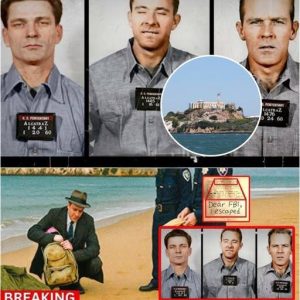
In the summer of 1962, three inmates—Frank Morris and brothers John Anglin and Clarence Anglin—carried out what would become the most talked-about prison escape in American history. Held inside Alcatraz, a facility considered impossible to flee, they quietly spent months widening ventilation openings, crafting tools from spoons, and molding realistic dummy heads to pass nighttime checks. What looked like an ordinary routine was, in reality, an intricate plan unfolding in plain sight.
Their most daring creation was a makeshift raft and life vests stitched together from stolen raincoats. On the night of June 11, the men slipped from their cells, climbed through service corridors, reached the roof, and disappeared into the darkness of San Francisco Bay. By morning, the deception was discovered—the dummy heads lay in their beds, the raft was gone, and the inmates had vanished. A massive federal search followed, but investigators ultimately concluded the men likely drowned in the cold, unpredictable waters.
That conclusion, however, never fully satisfied the public. Over the years, new details surfaced that kept the mystery alive. A letter that emerged decades later—allegedly written by John Anglin—claimed the escapees survived for years under assumed identities. Though handwriting analysis proved inconclusive, rumors intensified, especially after photographs surfaced showing two men in Brazil who strongly resembled the Anglin brothers. Each new detail added another layer to a story that refused to fade.
Modern analysis has only deepened the intrigue. Television experiments demonstrated that a raft like theirs could make the journey, and in 2018, researchers used advanced facial-recognition technology on a 1970s photograph from Brazil, finding striking similarities to the Anglin brothers. Whether the men perished in the bay or lived quietly in hiding may never be fully resolved. What endures is the fascination—an extraordinary blend of ingenuity, patience, and uncertainty that turned an “escape-proof” prison into one of history’s greatest unanswered questions.