
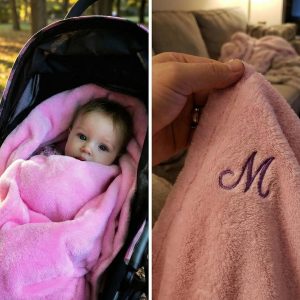
A year after losing my wife, Lara, life had become a quiet routine shaped mostly by my efforts to raise our son, Caleb. His laughter often felt like the only brightness in a house still adjusting to its missing heartbeat. One morning, on my way to a plumbing job, I cut through the woods the same way I always did—until a faint, trembling cry made me stop. Following the sound, I found an infant carrier tucked beneath a cluster of branches, holding a newborn girl wrapped in a thin blanket. She was cold, frightened, and alone. Without thinking, I brought her home, warmed her carefully, fed her, and called emergency services. The paramedics assured me my quick response had made a difference, but long after they left, my thoughts lingered on the tiny embroidered “M” stitched onto her blanket.
The next afternoon, a knock at the door brought a woman I recognized only from photos—Marissa, a college friend of Lara’s. We had never met, yet the look in her eyes told me she already knew the answer to her question: had I found a baby in the woods? When she explained that the child, Mila, was her daughter, the story behind that desperate moment unfolded. Marissa had been raising Mila on her own, overwhelmed by pressure, uncertainty, and fear about her daughter’s future. In a moment clouded by panic, she placed Mila where she believed someone responsible would find her quickly, staying nearby to ensure she was safe. Hearing her speak, I sensed not carelessness, but a young mother pushed to the edge and in need of real support—something she had struggled to find.
With guidance from a family lawyer, conversations opened between Marissa and Mila’s father. Instead of conflict, the discussions became a turning point. He acknowledged his missteps and agreed to take responsibility in a structured and supportive way. Legal arrangements were created to protect Mila, keep her with her mother, and ensure she received the stability she deserved. It wasn’t dramatic or adversarial—it was thoughtful, careful, and centered on the child’s well-being. For the first time since finding Mila, I felt the weight in my chest begin to ease. A situation that once felt frightening slowly shifted toward hope.
A month later, Marissa returned with a healthy, curious Mila in her arms. She looked steadier, more grounded—someone who finally had strength beneath her again. She thanked me for being there in her most vulnerable moment, though I never felt I had done anything extraordinary. What mattered was seeing Mila safe, thriving, and surrounded by people determined to support her. As Caleb toddled through the living room and Mila watched him with wide, fascinated eyes, I realized how much that moment in the forest had changed me. It reminded me that even in the quiet seasons of grief, there is still space to help others—and sometimes offering compassion becomes the very thing that helps us heal, too.