
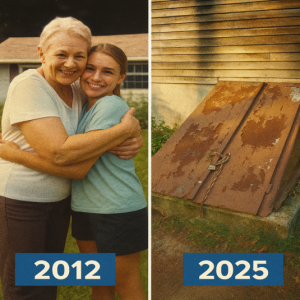
When my grandmother Evelyn passed away, I expected grief to show up in familiar ways—missing her voice, her routines, and the quiet steadiness she gave my world. She stepped in after my mother died, and her small, lavender-scented house became the only real home I knew. Walking through the door after the funeral brought everything back at once: the soft creak of the floorboards, the chair where she began every morning with tea, the spaces shaped by decades of her care.
As Noah and I sorted through her belongings—old recipes, faded photographs, small treasures tucked into drawers—I kept circling around the one place I’d never been allowed to enter: the basement. Evelyn’s rule had been firm and unwavering. I’d always assumed it was filled with rusted tools or forgotten boxes, and she was simply protecting me from a mess. When the rest of the house was finally in order, the basement was the only room left. I unlocked the heavy door, expecting disorder. Instead, the space felt deliberate, almost curated. Rows of boxes lined the walls, each labeled carefully in her familiar handwriting.
Inside were baby clothes, photographs, letters, and documents that told a story I had never heard. One picture stopped me cold—Evelyn, barely more than a teenager, holding a newborn who wasn’t my mother. The boxes revealed adoption records and pages of her personal notes, written over decades as she tried to trace the child she had been forced to part with. The basement wasn’t a storage space—it was a room where she kept a grief she never spoke aloud. Using the information she preserved, I began searching. After months of calls, paperwork, and a DNA test, I learned Evelyn’s first daughter, Rose, lived only a short distance away.
We met in a quiet café, both unsure, both carrying years of questions. I showed her the photograph—the one Evelyn had protected for most of her life—and explained that she had never stopped searching. Rose told me she grew up believing she was someone meant to disappear from her birth mother’s story, not someone deeply, quietly missed. We aren’t trying to rewrite the years that came before us. Instead, we’re building something steady and present. And every time I see a familiar curve of a smile or a spark in her eyes that mirrors my grandmother’s, I feel like I helped close a chapter Evelyn never stopped hoping to finish.