
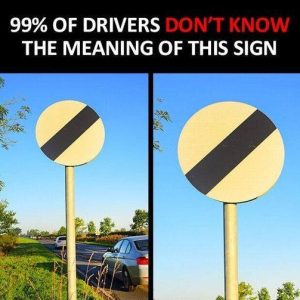
Every driver has experienced that split second of doubt—glancing at a road sign and thinking, Wait… what does that one mean again? A recent online discussion in the UK revealed just how common that uncertainty is, especially when it comes to one minimalist but important sign: a plain white circle marked with a single black diagonal stripe. Though it appears frequently on roads and even on the driving theory test, many motorists admitted they weren’t fully confident about its meaning once they were behind the wheel. When one user joked that “99% of drivers” misinterpret it, the conversation quickly expanded, showing how easily knowledge fades when driving becomes second nature.
This often-misunderstood symbol indicates the start of the national speed limit. Its clean, sparse design leaves plenty of room for confusion, leading to joking theories online—from “no rules apply” to “go as fast as you want.” Others shared concerns that some drivers see the sign as an invitation to accelerate aggressively or begin overtaking, even in conditions where it may not be safe. The comments highlighted a larger issue: while drivers study these rules thoroughly before earning their licence, habits tend to replace knowledge over time, and that disconnect can lead to unsafe decisions on the road.
According to the RAC, the national speed limit sign simply means that the previously posted limit no longer applies and drivers should follow the default speed for that type of road. For cars, that typically means up to 60 mph on single carriageways and up to 70 mph on dual carriageways and motorways. Other vehicles follow different rules—vans and cars towing trailers must adhere to lower limits, such as 50 mph on single carriageways and 60 mph on dual carriageways. In built-up areas with regular street lighting, the default speed remains 30 mph unless signs indicate otherwise. Because the sign displays no number, drivers must rely on awareness of the road type, the vehicle they’re driving, and the Highway Code.
Road safety experts also stress that speed limits are not goals—they are maximums. Weather conditions, road surfaces, traffic flow, and visibility may require drivers to slow down well below the posted limit. The renewed discussion surrounding this understated sign serves as a reminder that safe driving requires ongoing attention, not just what was memorized for a test. Refreshing our understanding of signs like this one—and approaching them with awareness rather than assumption—helps keep everyone safer on the road. A little extra knowledge can make a meaningful, everyday difference.