
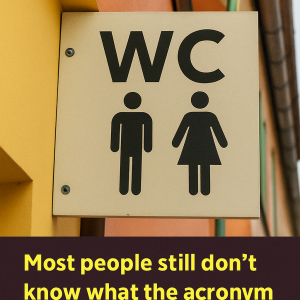
The term WC, short for “Water Closet,” traces back to 19th-century England, when indoor plumbing was still a luxury available only to the wealthy. It was used to distinguish the new indoor flushing toilets from the older outdoor facilities people relied on for centuries. Although the phrase itself has mostly slipped out of everyday conversation, the abbreviation “WC” has remained surprisingly persistent. You’ll still find it across Europe, Asia, and various international public spaces where a universal, easily recognized label is needed.
As indoor bathrooms became standard, different regions developed their own names for these essential spaces. Americans began using “restroom,” Canadians preferred “washroom,” and the British leaned toward “toilet” or “loo.” In the Philippines, people commonly refer to the “CR,” short for Comfort Room, while French-speaking regions use “toilettes.” Even with all these cultural variations, one thing helped bridge global communication gaps: simple, clear signage.
The familiar stick-figure icons—one figure in pants, the other in a skirt—were designed for instant recognition in airports, train stations, malls, and tourist destinations. Their minimalist style allowed travelers to understand them at a glance. Over time, some restaurants and cafés introduced playful twists using hats, bows, humor, or even animals to differentiate the doors. While charming, these creative designs occasionally leave visitors guessing which door is the correct one.
In recent years, restroom signage has continued to evolve. Many public buildings now include gender-neutral or all-gender restrooms, marked with blended symbols or straightforward text to promote accessibility and inclusivity. These modern signs aim to remain universally understandable while adapting to society’s shifting needs. So the next time you spot a WC sign, you’re not just seeing practical wayfinding—you’re glimpsing a small but fascinating piece of cultural and design history shaped over hundreds of years.