
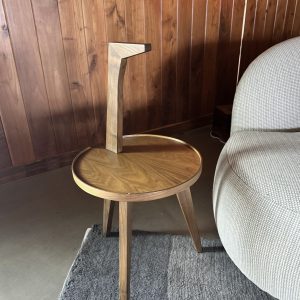
The first time I saw it, I didn’t even realize I was looking at a design icon. It stood quietly in the corner of a cabin-like living room, bathed in golden lamplight, surrounded by old books and well-loved furniture. Among the soft textiles and rustic charm, my eyes landed on a small, elegant side table unlike anything I’d ever seen. With its round top, three slender legs, and a graceful vertical handle rising like a bird mid-step, it felt almost alive. When I asked about it, my host smiled and said, “That’s a Cicognino — Franco Albini’s ‘little stork.’”
Once you know its name, everything about it becomes beautifully clear. “Cicognino,” Italian for “little stork,” perfectly captures both its shape and its spirit. Designed in 1954 by Franco Albini — one of Italy’s most celebrated modernists — the table embodies his philosophy of quiet function and poetic form. Every line serves a purpose: the handle for easy movement, the raised lip to keep objects in place, the proportions balanced like a perfectly composed melody. It’s the kind of design that whispers rather than shouts, revealing its brilliance slowly to those who take the time to notice.
Originally crafted in walnut or mahogany, the Cicognino stands just over two feet tall — the perfect companion for a book, a glass of wine, or a morning espresso. Its three-legged base gives it surprising stability, while its featherlight frame makes it easy to move with a single hand. Even after seventy years, it remains one of Albini’s most beloved creations — timeless not for its fame, but for its humanity. It’s the sort of object that feels as natural in a modern apartment as it does in a mountain cabin, connecting generations through its understated beauty.
Today, Cassina continues to produce the Cicognino, ensuring Albini’s vision endures. Collectors prize vintage originals, their wood worn smooth by time and touch. But beyond craftsmanship or prestige, what makes this table truly timeless is its soul — the sense that simplicity, when shaped with intention, can be deeply moving. Like its namesake bird, the Cicognino doesn’t demand to be seen; it simply stands with quiet grace, reminding us that elegance often speaks in the softest voice.