
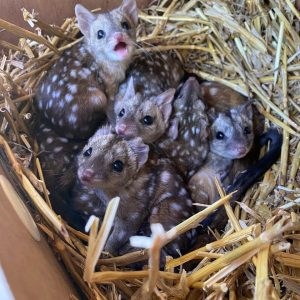
There is now hope for a species that was on the brink of extinction.A group of researchers in Australia is thrilled after their efforts to propagate the species seem to have succeeded.Recently, ecologists at the Mt Gibson Wildlife Sanctuary in Australia made a stunning discovery.In the sanctuary, they found a litter of newborn and spiky little creatures.
But these are not just any creatures. They belong to the species “western quolls,” which are a specific type of marsupial carnivore.
Previously, the species was scattered throughout Australia, but since the first Europeans began populating Australia, the population of the species has dramatically declined.
Nowadays, the western quolls, also known as chuditchs, are only found in the southwestern corner of Australia, and only in small clusters.
This species of marsupial grows to about the size of a cat and plays a significant role in the ecosystem. They help control populations of smaller invertebrates, as well as certain reptiles and birds.
Over the past few months, researchers have been working to reintroduce the marsupials to the Mt Gibson Wildlife Sanctuary, an area where they had previously been extinct.
Now, with the recent discovery of baby marsupials, it’s clear that the researchers have succeeded. It seems that the animals are thriving there and have no issues reproducing.
“Through regular monitoring, we can see the quolls are doing well at the sanctuary and encountering the first pouch young is a positive sign that they have adjusted to the new environment,” said Georgina Anderson, AWC Senior Field Ecologist.
“One quoll that we’ve named Aang is a regular at camera traps we set up at the release sites. He is one of our largest and most striking quolls with a personality to match – often making rounds of multiple sites to collect the chicken we use as lures and disrupting our bait canisters,” she added.
What joy to see hope for the species! Hopefully, it can soon thrive throughout Australia again!
Feel free to share this article to spread some good news on Facebook!