
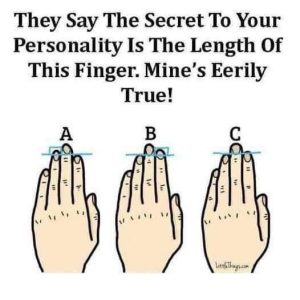
In certain pseudoscientific theories, particularly those related to palmistry or hand analysis, it is believed that one’s personality traits are ‘defined’ by the length of their fingers.
Personality is influenced by a complex blend of genetic, environmental, and psychological factors, and can’t be precisely determined by physical characteristics like finger length. Yet, there are those who think otherwise.
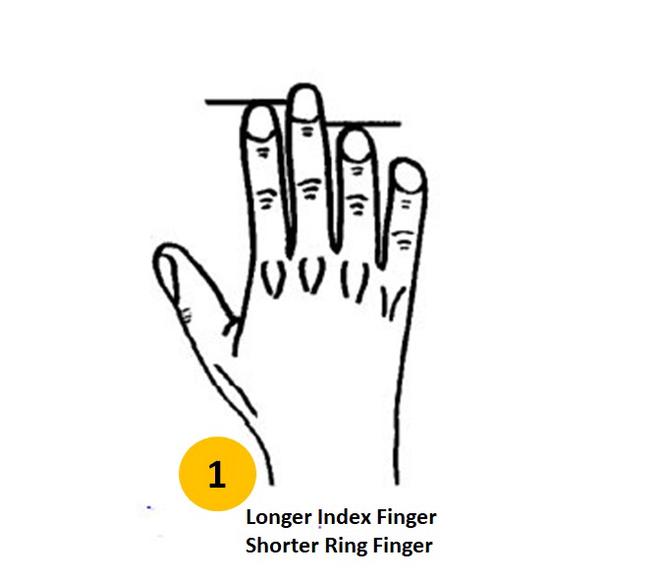
Based on a pseudoscientific concept called the “digit ratio,” particularly focusing on the ratio between the index finger (2D) and the ring finger (4D), certain aspects of person’s personality can be easily determined.
Some of the interpretations are as follows:
Longer Ring Finger (Low 2D:4D Ratio): Having longer ring finger is often associated with people who are believed to be risk-takers, assertive, and have high self-esteem. Further, these people are believed to be competitive, ambitious, and outgoing.
Longer Index Finger (High 2D:4D Ratio): Having longer index finger is associated with people who are compassionate, emphatic, communicative, and nurturing. These individuals tend to avoid conflicts.
Equal Length: These individuals might display a combination of assertiveness and empathy, showing both competitive and cooperative behavior depending on the circumstances.
According to Science, the idea that finger lengths reveal significant personality characteristics comes from evolutionary biologist John Manning, now at Swansea University. His work has inspired over 1,400 studies in just over 20 years, linking finger ratios to personality, cognitive abilities, and disease risks. Some researchers have even used these ratios to speculate on the gender of ancient cave painters.
Further, the magazine writes that finger ratios emerged as a solution in the late 1950s when researchers linked prenatal testosterone to brain development and behavior. With fetal hormone sampling being risky, scientists use finger ratios as a non-invasive way to study traits influenced by prenatal hormones, like aggression and sexual orientation.
Tell us what you think about this!