
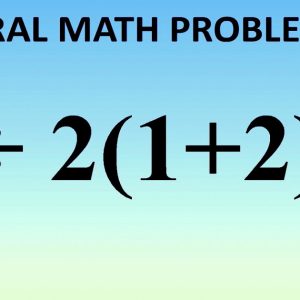
You’re bored, and you decide to search for math problems to solve only to find yourself at your wit’s end trying to figure out how to solve this tricky problem.
This math problem is not new. You may have seen it a couple of times on social media. And once every two or three years, it goes viral again to test both kids and adults in solving this grade school math problem.
This equation was already shared millions of times on Facebook and has taken people’s time in solving this tricky problem.
What’s funny is that this simple equation even sparked debates around the world as to what is the proper way of solving the math problem.
Are you one of the people who tried solving this too?
The trick question
Here is the tricky and viral math problem:
6÷2 (1+2)
It may look tricky because of the different answers that we are getting, but this is more of a simple math problem that only gets confusing because of how you solve it.
YouTube channel MindYourDecision posted how it’s actually very easy to solve this problem. According to the video’s description:
“I explain how to get the correct answer by using the modern interpretation of the order of operations. I also explain how you would get a different answer under historical usage of the division symbol.”
Before we can solve this math problem, we need to refresh our memory about the PEMDAS rule and the order of operations.
(If the same precedence, then solve left to right)
Now that that is clear, here’s how you solve the problem.
6÷2 (1+2) = 9, and here’s why
The answer to the math problem 6÷2 (1+2) is 9!
How did we get this answer? Here’s the breakdown.
Keeping PEMDAS in mind, the math problem should look like this:
6÷2× (1+2)
Now, P stands for parentheses, so the first thing that you would do is 1 + 2 = 3, hence:
6÷2× (3) or 6÷2× (3)
Again, with the PEMDAS rule, multiplication and division have the same priority, so we should evaluate this from left to right.
6÷2 = 3 then 3 x 3 = 9
Now, MindYourDecisions also tried another order of operations from the old textbook about the historical usage of 1917.
Here’s how some people solved the problem:
Using the order of operations, the one in the parenthesis comes first, so
6÷2 (1+2) = 6÷2 (3)
Then, you multiply 2 and 3 to get 6 which makes it 6÷6 = 1.
While there is a valid justification for the old computation, the correct answer would still be 9 since this is how we would interpret the equation today.
Come to think of it, answering these types of tricky math problems are a great way to spend your free time. Plus, you are also developing strategic solving skills.
Did you get the correct answer to this math problem the first time?