
But puzzles aren’t just for puzzle enthusiasts. They offer incredible benefits for everyone, regardless of their preference. Solving puzzles is like a workout for the mind, keeping it sharp and agile. It trains the brain to approach problems from different angles and encourages creative thinking to find solutions.
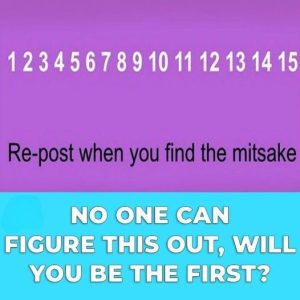
One particular puzzle has taken the internet by storm, leaving many scratching their heads. At first glance, it seems like an ordinary picture of numbers from 1 to 15 neatly arranged. The challenge is to find the error and repost the image. Seems simple enough, right?
But as you search for the error, you realize something strange. The numbers are perfect, with no missing or incorrect ones. You examine them closely, looking for a hidden pattern or sequencing, but find nothing. They are perfectly arranged.
At this point, you start thinking outside the box. Maybe the error lies in the absence of zero? Or perhaps the number sixteen should be included? Or is it something else entirely? You analyze every detail, from the spacing to the shape of the numbers. But the answer continues to elude you.
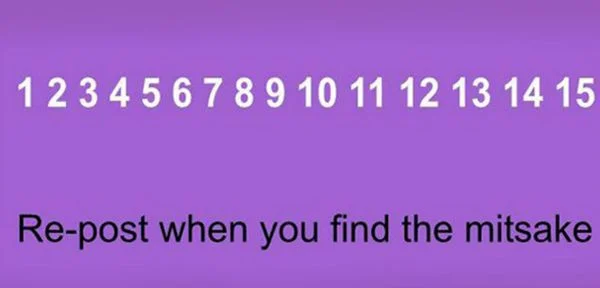
Then, it hits you. The mistake isn’t in the numbers at all. It’s in the sentence below, asking you to find the ‘mitsake’ instead of the error. Clever, isn’t it? Most people are so focused on the numbers that they completely miss the misspelled word.
This puzzle teaches us an important lesson – sometimes we need to look at the bigger picture to find the solution. We get so caught up in the details that we miss the obvious. By training our minds to see beyond the surface, we become better problem solvers.
The Far-Reaching Benefits
The benefits of solving puzzles are far-reaching. Research has shown that they improve memory, especially short-term memory. Puzzles challenge our minds to think quickly, enhancing mental processes and strengthening the connections between brain cells.
Moreover, puzzles develop our analytical skills. They require logical and critical thinking, as well as creativity. Just like the puzzle we encountered earlier, they teach us to analyze the whole picture and think outside the box. These skills can be applied to everyday life, helping us solve problems that have no obvious solutions.
In fact, the ability to think analytically is highly valued in the workforce. It sets individuals apart, making them stand out in areas like leadership and management. By cultivating the habit of solving puzzles, we can enhance ourselves with these sought-after skills.
So, the next time you come across a puzzle, take a moment to embrace the challenge. Whether it’s a crossword, Sudoku, or a mind-bending riddle, you’ll be exercising your mind and reaping the countless benefits. Happy puzzling!